Search

AnotherOther

#Work #Culture #Organizations #Languages

Author

ashases

Distraction

Funny phenomena with writing a thesis is that the mind starts to ramble towards not so relevant things. Fishman’s (1971,1972) question “who speaks what language to whom and when” started to bother me.  

When do we actually decide what language to speak? We know our mother tongue by heart thanks to the socialization process. Then there are languages appropriate to use in certain geographical or political areas. Or we use language based on the language proficiency of the individuals surrounding us. Voin itse päättää, että hähä, puhumpa nyt suomea koska haluan. But what use that would have when by choosing language dictatorially, the audience shrinks drastically?

Language choice seems to me always to be a two-way street, so called “kahden kauppa” negotiated in the situational context based on previous knowledge. In the end the language is used to communicate whereas the ultimate aim is that the receiver gets the main idea. Fuese lo que fuese la forma de transmitirlo.


Fishman, J. A. 1971 The link between microand who speaks what language to whom and when. J.A.Fishman, R.L.Cooper and R.Ma, 583-604. macrosociolingustics in the study of Bilingualism in the Barrio, ed. by Bioomington: Indiana University

Coming from the heart

Let’s face it. Most people don’t love to give oral presentations (Theo Tsaousides Ph.D. – Psychology Today). They give them because they have to either for academic or labor demands. Occasionally the presentation has to be given in another language and night sleep is lost, fingernails get shorter and knees are shaking. In addition to the stage fright, language matters take over. Pronunciation, wording, structure… all become an additional obstacle. Another side of the coin is that by using an unfamiliar language, people low down perfectionism and feel freer to speak.

Either way, in whichever language, when the message comes from the heart, there is no stress, no fear. Just desire to share.

For the holy translators

Last night I was reading a book. The book ended in my hands accidentally. I had been wondering around second-hand shops looking for completely another thing, but stopped to flip through some books, ones in better shape than others. The price was 0,50 euros per kilo. Interesting way of pricing knowledge and feelings by the way. However, one book caught my attention – it was brand new, not even a fingerprint on it and it was written by a writer whose name I vaguely recalled. So, I bought it.

“The Holy Translator”. Nowadays the first thing people think is the all mighty Google. Well, this is not the case. It was a reflection about a man who devoted his whole life to translation and creating an alphabet. And he is not the only one. There are other passionate souls dedicated to sharing knowledge by creating, writing and translating. Thumbs to them. Knowledge sharing culture is still alive and kickin’.

Language rage

A Finnish newspaper published a piece of news mentioning shocking words about language rage,“Mainos herätti kieliraivon: “Puhukaa amerikkaa”. The reason was an advertisement video showed during the Super Bowl. Apparently, language diversity was too much to handle for some people. Just English was supposed to be spoken. No one can deny that English would not be one of the dominant languages of the world _but_but_but.

I find it sad that people react so strongly and negatively towards a language they cannot understand. Maybe there is a hidden feeling of rejection, being excluded, left out from the group when hearing language without being able to know the meaning. What are they saying? Are they laughing at me, at us?

Language and culture are inseparable. Culture instead forms a great part of our identity. That may be why some feel personally attacked, or even violated before an unknown language. Diversity should not be treated as a threat but a possibility. A chance to learn, experience and live.

Life is about discovering.

Baby talks

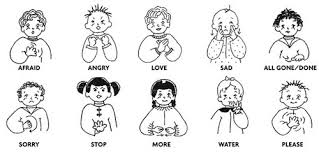
One of my friends has a baby and one day we were discussing communication with the little one. I heard something new and at first completely unbelievable. They were teaching her sign language! Both parents are hearing so why to teach sign language to also perfect hearing children? “Weird”, I wondered, made some research and indeed, there is a sign language just to help the parent to communicate with their babies who cannot yet talk. Hand gestures are used to indicate the parents whether the baby wants to eat, feel too cold or hot or just need some affection. Magic!!

However this made me wonder, how about we developed this further and had universal, not cultural related (is that even possible?), sign language for the basic needs? Language barriers would decrease and the utopia of universal understanding would be a bit closer. More Love Please.

Baby sign language


Mixing things up

In this fast and global world, most of us use more than one language to communicate with each other on a daily basis. Myself, I studied MA in English, I’m native Finnish and able to communicate in Swedish if necessary, I struggle with German, speak very fluent Spanish and make accurate guesses in Portuguese. And still, there some communication patterns that can be found in all this mess.

Uskomatonta mutta totta. The way of communicating is reflected not just in the use of tone, volume or non-verbal communication but also in the way of saying things. Y menuda frustración when there is a saying in one language which just CAN NOT be translated containing the exact same meaning and feeling into another. Många gånger when the feeling is needed to be transferred, the most natural way is to do it in a language that feels more accurate. Even when it requires quoting, putting somebody else’s words in your mouth, just to try to make the other feel like you do.

Blog at WordPress.com.

Up ↑